
The Story of Jesus Christ
From a quiet village in Galilee to an empty tomb outside Jerusalem, the story of Jesus is the story of God stepping into human history with a mission of love, rescue, and restoration. This blog walks through that story from the moment God revealed His plan to Mary and Joseph, through Jesus’ death and resurrection after three days, and into the ongoing mission that continues through His followers today.
When heaven knocked on Mary’s door, Nazareth was an ordinary, overlooked town, the kind of place no one expected history to turn on. Mary was a young woman engaged to Joseph, a craftsman descended from Israel’s great King David, planning a simple, ordinary life. Then everything changed. God sent the angel Gabriel to Mary with a message that sounded impossible: she would conceive a child by the power of the Holy Spirit, and this child would be called Jesus, the Son of the Most High. He would receive the throne of David and reign forever; His kingdom would never end. Mary asked the obvious question how could this happen, since she was a virgin? but the answer was not a biology lesson; it was a promise that with God nothing is impossible. Mary’s response is one of the most beautiful moments of trust in all of Scripture. Instead of arguing, bargaining, or running away, she surrendered: she accepted God’s will even though it meant misunderstanding, risk, and a future she couldn’t control. Faith, in her life and in ours, often begins right there: not with having every detail explained, but with saying “yes” to God while still trembling.
While Mary was carrying this incredible promise, Joseph faced what looked like a devastating betrayal. From his perspective, his fiancée was pregnant, and he knew the child was not his; the only logical conclusion was that she had been unfaithful. Joseph was called “righteous,” not only because he cared about God’s law, but because he also cared about mercy. Instead of exposing Mary to public shame or even punishment, he planned to end the engagement quietly. At that moment when he had decided, but before he acted God stepped in. In a dream, an angel told Joseph not to be afraid to take Mary as his wife, because what was conceived in her was from the Holy Spirit. Joseph was told to name the child “Jesus,” which means “the Lord saves,” because He would save His people from their sins. Joseph woke up and did what the angel commanded. His obedience is quiet but powerful: he chose trust over appearance, faith over reputation. Sometimes following God looks like exactly this staying, protecting, and standing beside someone because God has spoken, even when others would misunderstand.
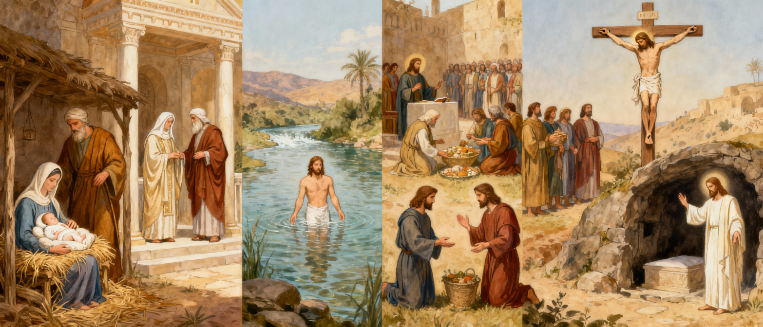
Not long after, a decree from the Roman emperor forced everyone to travel to their ancestral towns for a census. For Joseph, that meant leaving Nazareth and going to Bethlehem, the city of David, with Mary who was now heavily pregnant. Bethlehem was crowded, and there was no proper room available for them. In the simplest, humblest conditions surrounded not by royal attendants but by animals Mary gave birth to Jesus. She wrapped Him in cloths and laid Him in a manger, a feeding trough. The promised King, the Son of God, arrived not in a palace but in poverty, showing that God is not afraid of our low places. While almost no one in town noticed, heaven could not stay silent. In nearby fields, angels appeared to shepherds ordinary, often despised workers announcing good news of great joy for all people: a Savior, the Messiah, the Lord, had been born. The sign was not a crown or a throne, but a baby in cloths, lying in a manger. The shepherds hurried to Bethlehem, found the child, and became the first human witnesses and evangelists of the newborn King. From the beginning, God chose to reveal Jesus to the humble and overlooked, reminding us that no one is too small or too broken to be invited into His story.
Some time later, learned men from the east often called maginoticed an unusual star and understood it as a sign of a newborn king of the Jews. They traveled a long distance, first arriving in Jerusalem, the center of Israel’s religious and political life, expecting to find the child in the capital. Instead they met Herod, a ruler known for his paranoia and cruelty. When he heard about a possible “king of the Jews,” he felt threatened. Religious scholars told the visitors that the Messiah was to be born in Bethlehem, and Herod told the magi to report back once they found the child, pretending that he wanted to worship Him too. Following the star, the magi found Jesus with Mary, and they bowed down in worship. They offered gifts: gold, frankincense, and myrrh fitting for a King, a Priest, and One destined to suffer. Warned in a dream not to return to Herod, they went home another way. Herod, furious at being outwitted, ordered the killing of boys in Bethlehem two years old and under, hoping to eliminate the Child he saw as a threat. Before the soldiers arrived, Joseph received another warning in a dream and fled with Mary and Jesus to Egypt. The Son of God began life as a refugee, sharing the experience of those who are forced to run from violence and injustice. After Herod died, Joseph was led back, not to Bethlehem but to Nazareth, where Jesus grew up. God’s promises kept unfolding, often through danger and disruption, yet never out of His control.
The Gospels give only one snapshot of Jesus’ childhood beyond His birth. When He was about twelve, His family went up to Jerusalem for the Passover festival, a yearly remembrance of God rescuing Israel from slavery in Egypt. On the journey home, Mary and Joseph realized Jesus was missing. After frantic searching, they found Him in the temple, sitting among the teachers, listening and asking questions, and everyone was amazed at His understanding. When His parents expressed their distress, He answered with words that hinted at His identity: He needed to be in His Father’s house, about His Father’s business. Yet after this moment, Jesus went back with them to Nazareth and lived in obedience, growing in wisdom, stature, and favor with God and people. Most of His first thirty years were quiet and hidden: working, learning, praying, participating in ordinary village life. These years remind us that God often prepares us in obscurity and everyday faithfulness long before any “public” calling appears.
When Jesus was about thirty years old, a new prophet appeared in the wilderness: John the Baptist. John called people to repentance, to turn from sin and be baptized in the Jordan River as a sign of a new beginning with God. Jesus came to John to be baptized. John hesitated, knowing Jesus was greater than him, but Jesus insisted, choosing to stand with sinners even though He had no sin of His own. As He came up from the water, the heavens opened, the Spirit descended on Him like a dove, and a voice from heaven declared: “You are my beloved Son; with You I am well pleased.” This was a public affirmation of who He was and the start of His mission. Right after this glorious moment came a fierce testing. The Spirit led Jesus into the wilderness for forty days, where He fasted and faced intense temptation from the devil. The temptations urged Him to use His power selfishly, to test God, and to grab worldly glory without the cross. Jesus refused each offer, standing on God’s word and remaining faithful. Before He ever preached a sermon, He won a quiet victory in the desert that would shape His whole ministry.
Jesus went back to Galilee in the power of the Spirit and began to proclaim a simple, world-changing message: the kingdom of God has come near; repent and believe the good news. He didn’t build a movement by recruiting famous scholars or political leaders; He called ordinary people. By the Sea of Galilee, He saw fishermen throwing nets and said, “Follow Me, and I will make you fishers of people.” Peter and Andrew, James and John left their boats and livelihoods to walk with Him. He later called a tax collector named Matthew someone despised as a collaborator with occupying Rome and made him a disciple as well. Around Him formed a diverse, imperfect community learning to live under a new King. These disciples did not understand everything. They stumbled, misunderstood His words, argued about who was greatest, and sometimes were afraid. But they stayed close to Him, and He patiently taught, corrected, and sent them out in pairs to practice proclaiming and serving. Jesus’ mission was never just about crowds; it was about forming people who would carry His life and message to the world.
Wherever Jesus went synagogues, hillsides, streets, homes people were struck by His authority. Rabbis often quoted long chains of teachers; Jesus spoke as if He stood directly in the place of God’s wisdom. He used parables: short, vivid stories about farmers, seeds, lost coins, rebellious sons, and generous fathers. Through them He described God’s kingdom as a hidden treasure worth everything, a tiny seed that becomes a great tree, a banquet where outcasts are invited and honored. His teaching cut through religious pride and comforted the broken-hearted; He blessed the poor in spirit, the mourners, the meek, and those hungry for righteousness. Jesus summarized God’s will in two commands: love God with all that you are and love your neighbor as yourself. He insisted that love, mercy, and justice were at the heart of God’s law, not endless rule-keeping without compassion. He called His followers to forgive, to pray for their enemies, to give secretly, and to live for God’s reward rather than human praise.
Jesus’ words were accompanied by works of power and compassion. People brought Him the sick, the demonized, the paralyzed, and those no one else could help, and He healed them. He touched lepers others avoided, gave sight to the blind, and made the lame walk. He calmed raging storms with a word, showing authority over the natural world. He fed thousands with a few loaves and fish, revealing God’s generosity in the face of scarcity. He even raised the dead, including a synagogue leader’s daughter and His friend Lazarus, hinting at a deeper victory coming. These miracles were not random displays of power; they were signs of the kingdom. Wherever Jesus went, brokenness began to reverse: sickness, oppression, and despair met healing, freedom, and hope. Through Him, people saw that God’s heart is not indifferent to human suffering, but deeply moved to restore.
The more Jesus healed and taught, the more the crowds grew and so did hostility. Many religious leaders were troubled by His authority, His claim to forgive sins, His habit of eating with sinners and tax collectors, and the way people whispered “Messiah” about Him. Several times, Jesus began to tell His disciples that He would suffer, be rejected, and be killed in Jerusalem, and then rise on the third day. They could not understand how the Messiah could possibly die; they imagined victory through political power, not a cross. Jesus kept reframing greatness: whoever wanted to be first must be servant of all, and He Himself had come not to be served but to serve and to give His life as a ransom for many. As Passover approached, the conflict was no longer hidden. Leaders plotted to arrest Him quietly, afraid of the crowds, while Jesus set His face toward Jerusalem, knowing what waited there.
Jesus entered Jerusalem riding on a young donkey, fulfilling ancient imagery of a gentle King bringing peace. Crowds went before Him and followed after, spreading cloaks and branches on the road and shouting praises, welcoming Him as the Son of David, the expected King. Yet their expectations were mixed. Many hoped He would overthrow Roman rule and restore national glory. Jesus instead went straight to the temple, the heart of Israel’s worship, and drove out those buying and selling, overturning tables and condemning those who turned a house of prayer into a marketplace. This prophetic act struck at the center of religious and economic power, making Him many powerful enemies. In the days that followed, Jesus taught openly in the temple, told parables that exposed hypocrisy, and answered challenges from various groups. While crowds listened, leaders looked for the right moment to seize Him.
On the night before His crucifixion, Jesus shared a final Passover meal with His disciples. Passover remembered how God freed Israel from slavery in Egypt by the blood of a lamb; now Jesus was about to give new meaning to that story. He took bread, gave thanks, broke it, and gave it to them, saying it represented His body given for them. He took a cup of wine and said it was the new covenant in His blood, poured out for many for the forgiveness of sins. In this moment, He showed that His death would not be a random tragedy, but the center of God’s plan—a sacrifice that would seal a new relationship between God and humanity. He also washed His disciples’ feet, taking the role of the lowest servant, and told them to do likewise: to love one another as He had loved them. At this same table, He revealed that one of them would betray Him and that Peter, one of His closest friends, would deny Him before the next day’s sunrise. He was not caught off guard; He chose love knowing full well the weakness and failures of His friends.
After the meal, Jesus led His disciples to a garden called Gethsemane, at the foot of the Mount of Olives. There, He told some of them to keep watch and pray while He went a little farther to pour out His heart to the Father. In deep anguish, He prayed that if it was possible, the cup of suffering might pass from Him. Yet each time He ended with surrender: not His will but the Father’s. His sweat fell like drops of blood; the weight of what He was about to endure pressed in on Him. Even in this agony, He chose obedience and love. While He prayed, His disciples struggled and fell asleep. Then came the sound of footsteps and weapons. Judas, one of the Twelve, arrived leading a crowd sent by the authorities. He identified Jesus with a kiss, turning a sign of affection into a mark of betrayal. Jesus did not resist. When one disciple struck with a sword, Jesus stopped him and healed the wounded servant, insisting that His kingdom would not be advanced by violence. Arrested and bound, He was led away while His disciples fled.
Jesus was taken first to the Jewish leaders, who questioned Him and sought grounds to condemn Him. They accused Him of blasphemy because of His claims about being the Messiah and the Son of God, and they judged Him worthy of death. But only the Roman authorities could carry out an execution, so He was brought to Pontius Pilate, the Roman governor. The charges were now political: that He claimed to be a king and stirred unrest. Pilate questioned Him and seemed unconvinced He was a threat deserving death, yet pressure from the crowd and leaders grew. In the end, Pilate handed Jesus over to be flogged and crucified. Roman soldiers mocked Him, dressing Him in a robe, placing a crown of thorns on His head, and hailing Him as “king” in cruel sarcasm. The true King stood silent in humiliation, carrying our rejection and shame.
Jesus was led out of the city to a place called Golgotha, “the place of the skull.” There, He was nailed to a wooden cross between two criminals. Crucifixion was designed to be slow, excruciating, and public a warning to anyone considering rebellion. As He hung there, people passed by, some mocking Him and challenging Him to save Himself if He was truly the Son of God. Religious leaders jeered that He had saved others but could not save Himself. Yet the truth was deeper: He chose not to save Himself so He could save others. He prayed for His executioners, asking the Father to forgive them because they did not know what they were doing. One criminal beside Him joined in the mockery, but the other recognized his own guilt and Jesus’ innocence and asked to be remembered in His kingdom. Jesus promised him paradise that very day a stunning act of grace in His final hours. At last, after hours of agony, Jesus cried out and gave up His spirit. The Gospels describe darkness covering the land and the temple curtain tearing from top to bottom, symbolizing that the barrier between God and humanity was being removed.
Jesus’ body was taken down from the cross by Joseph of Arimathea, a respected council member who had not agreed with the decision to execute Him. Joseph wrapped the body in linen and laid it in his own new tomb carved in rock, and a large stone was rolled across the entrance. For Jesus’ followers, this was a moment of deep despair. The Teacher they had left everything to follow was dead; the kingdom they hoped for seemed lost. They hid in fear and grief, unsure what to do next. Because some leaders remembered Jesus’ words about rising on the third day, they asked Pilate for a guard at the tomb. Soldiers were stationed there, and the stone was sealed, as if human power could keep the Author of life contained.
Early on the third day after His crucifixion, while it was still dim, some women who had followed Jesus went to the tomb with spices to anoint His body. They expected grief; they expected death; they expected a sealed stone. Instead, they found the stone rolled away and the tomb empty. Angels appeared and announced the world-changing news: Jesus was not there He had risen. They reminded the women of His own words, that He would be handed over, crucified, and rise on the third day. The women ran to tell the disciples, who at first thought their words sounded like nonsense. But soon Jesus Himself began to appear: to Mary Magdalene in the garden, who recognized Him when He spoke her name; to two disciples on the road, whose hearts burned as He explained the Scriptures; to the gathered disciples behind locked doors, breathing peace on their fear. The resurrection was not a vague spiritual idea; it was a bodily victory over death. Jesus ate with them, showed them His wounds, and allowed them to touch Him, yet He also appeared and vanished in ways that showed He now lived a transformed, glorified life. Their fear turned to courage, their despair to joy, their confusion to conviction: Jesus was alive, and everything had changed.
After His resurrection, Jesus spent a period appearing to His followers, teaching them, and opening their minds to understand how the Law, the Prophets, and the Psalms all pointed to His suffering, death, and rising. He showed them that repentance and forgiveness of sins would be preached in His name to all nations, starting from Jerusalem. He gave them a commission: go and make disciples of all nations, baptizing them and teaching them to obey everything He commanded, with the promise that He would be with them always. What began in a small corner of the Roman Empire was meant to reach the ends of the earth. Finally, Jesus ascended to heaven, where He is described as reigning at the right hand of God, yet still intimately involved in His people’s lives through the Holy Spirit. His mission did not end at the empty tomb; it continues through every person who trusts Him, receives His forgiveness, and learns to live His way of love, justice, and mercy in the world. We believe that one day Jesus will return to judge evil fully and renew creation, bringing to completion what He began in that manger, on that cross, and at that garden tomb. Until then, His story and His mission continue in the pages of Scripture, in the history of the church, and in the lives of all who follow Him today.
Written by Victor Akande
